Upskill Pro
Success stories5 min read
Worked exampleP&G: use AI to widen the product conversation before choosing
A published P&G field experiment shows how AI can connect commercial and technical perspectives. Here is a management reconstruction for a bounded innovation decision.

The P&G innovation experiment supports using AI to broaden the options a product team can examine, while keeping human judgment responsible for selecting what deserves a real test.
What did the published P&G experiment establish?
The June 2026 Organization Science article analyzes 791 P&G professionals in a preregistered innovation experiment. Participants worked individually or in commercial–R&D pairs, with or without AI. AI-assisted individuals matched the performance of teams without AI, and proposals combined functional perspectives more effectively. The article also finds a continuing role for human judgment in evaluative selection. PG26
The setting was a bounded product-development workshop. Proposal quality is not the same as a successful product launch, and the result does not establish the long-run value of removing a function or reducing a team. The published article’s 791-person analysis differs from the earlier 776-person working-paper description; this article follows the published version.
The management decision is which uncertainty to test
A product leader does not need unlimited ideas. The leader needs to choose a customer problem and a next experiment that the team can actually run. AI can help a commercial specialist recognize technical dependencies and help an R&D specialist frame buyer value. Those contributions become useful when the team can distinguish a plausible idea from an opportunity with evidence.
The reconstruction below is our proposed application of the Upskill Decision Loop to this kind of work. It is not a record of P&G using the Loop, nor a copy of its internal decision process. It is intended for a product or business-unit team deciding what to investigate before committing development capacity.
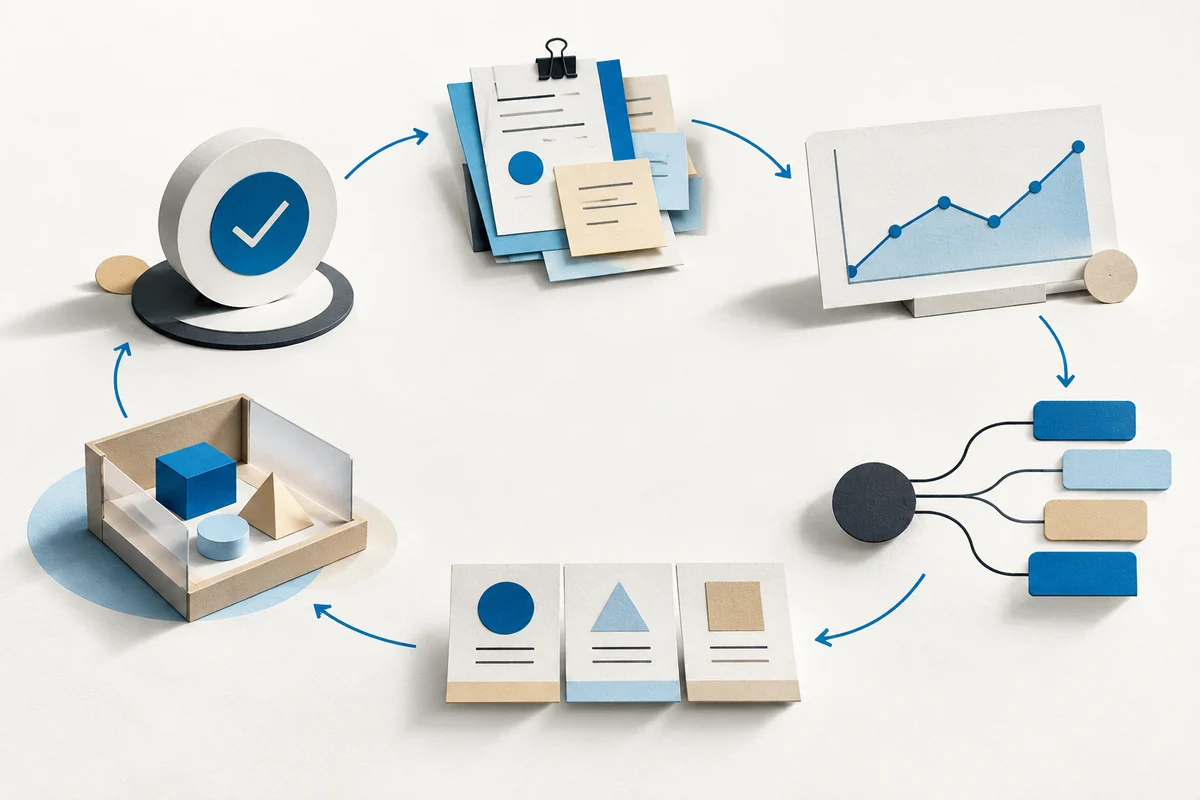
Follow the Decision Loop from signal to a testable option
Signal: collect authorized customer observations and the technical constraint that makes the problem hard. The commercial owner identifies what customers actually said; the technical owner identifies what is known about feasibility. Neither treats a model-generated benefit as observed demand.
Structure: create an opportunity brief that separates customer need, technical dependency and commercial assumption. Options: compare a narrower product change, a service response and a decision to gather more evidence. AI prepares the comparison; the specialists challenge the assumptions behind their own and the other function’s preferred route.
Pilot: the product owner chooses one uncertainty to test and names the person who will collect the evidence. Measure: review whether the test changed the demand or feasibility assumption, not whether the team generated more ideas. A proposal that survives discussion is still a proposal until the relevant commitment is authorized.
What should the team take away from the discussion?
The useful output is an opportunity decision brief. It records the customer problem, evidence available, strongest technical objection, competing response, chosen uncertainty and next review. Put the unresolved disagreement beside the choice so that a later reader can see what the team is accepting conditionally.
For a first local application, a product lead can ask commercial and technical owners to prepare separate objections before seeing the shared recommendation. Then use AI to help compare those objections against the same decision criteria. This keeps the model from becoming the single author of both the framing and the apparent consensus. It also makes the contribution of each specialist visible.
Where can this pattern fail?
The central risk is breadth without selection discipline. A richer proposal can hide an unsupported customer promise or make a technically weak option sound balanced. A common AI brief can also anchor both functions to the same assumptions. Preserve an independent customer check and an independent feasibility challenge rather than measure the quality of the shared narrative alone.
The experiment offers evidence about a specific workshop configuration and task. It does not resolve your company’s data permissions, product economics or implementation dependencies. Those require local evidence. Nothing in this case establishes Upskill Pro customer adoption or a measured product outcome.
What should a product manager try next week?
Choose one live opportunity that is still reversible. Ask the commercial and technical owners to document the signal, their initial objection and the evidence they would need to change their view. Have a decision owner compare the existing preparation process with an AI-supported brief on the same opportunity and authorized inputs; keep the evaluation criteria and source access consistent.
For this first comparison, prepare two briefs independently for the same opportunity from the same authorized inputs: one through the existing route and one with AI support. The evaluator uses the pre-agreed rubric and checks the order effect. This is a feasibility comparison on one opportunity, not a causal estimate across the product portfolio. Repeat on another opportunity before drawing a wider conclusion.
Use an evaluator who did not author the proposal and hide the preparation route when practical. Agree the scoring rubric before comparing briefs and vary the order in which proposals are reviewed. Otherwise novelty, the facilitator’s expectations or an author scoring their own work can create the appearance of better selection without a better opportunity.
The product owner pauses the affected proposal immediately if a material source fails verification, a required specialist objection is excluded or authority is missing. Review the remaining preparation pattern after two opportunity discussions. Continue only if the shared brief surfaces useful cross-functional challenges and improves the evidence behind the selected test. Change the pattern if the team selects more polished but less testable ideas, loses specialist objections, or cannot explain why one option was chosen. The first positive value event is a better experiment decision, not a promise of product-market fit.
Questions managers ask
Did P&G replace its teams with AI?
The cited study does not establish that. It compared individuals and pairs on a bounded innovation task and examined the quality and functional balance of proposals.
Why does this article use 791 participants rather than 776?
It follows the June 2026 published Organization Science article. Earlier working-paper versions described a 776-person sample; the published paper also explains complete post-task survey counts.
Is the Decision Loop P&G’s reported methodology?
No. The experiment is the public evidence. The five-step Loop and proposed pilot here are our management reconstruction for readers to test in their own context.
Sources and scope
PG26: The Cybernetic Teammate: A Field Experiment on Generative AI and Teamwork — Organization Science; 2026-06-12. Primary peer-reviewed field experiment; public full text.
Research checked 2026-10-27. Next review 2026-11-27. Suggested pilots are editorial proposals, not observed Upskill Pro customer results.